
Building a “Trust Scorecard”: New Metrics for Measuring PR Success in Finance
For years, PR teams measured success by counting press clippings and tracking website clicks. These numbers look good on a report. But they do not tell you if your communications actually build trust. In financial services, trust is the most valuable asset. Without it, you have nothing.
A “Trust Scorecard” changes the game. It replaces vanity metrics with real indicators of credibility. It helps you see what journalists, investors and customers actually think about your brand. And it gives you a clear path to improve.
This guide explains how to build a trust scorecard for your financial services PR in Ireland. It covers the metrics that matter, the tools you can use, and the steps to get started.
Why Traditional PR Metrics Fail in Finance
The old way of measuring PR focused on volume. How many articles? How many impressions? How many social shares? These numbers are easy to collect. But they are also easy to ignore.
In finance, a high volume of coverage does not equal trust. A company can be mentioned everywhere and still be seen as unreliable. Prospects do not ask “how many outlets covered you?” They ask “what shows up when I look you up?”
Traditional PR measures activity. But financial markets reward credibility. And credibility needs a different type of measurement.
The Trust Problem Most FinTechs Don’t See
Many fintech teams think they have a marketing problem when growth stalls. Traffic drops. Conversion rates fall. Sales cycles get longer.
In reality, the problem is often confidence, not messaging. Fintech buyers evaluate products differently than normal software. They evaluate them like a risk decision. Before features and pricing matter, they look for proof that you are legitimate, stable and credible.
That proof comes from external signals:
- Search results that either validate you or raise doubts
- Reviews on platforms like Trustpilot
- Media sentiment and third-party mentions
- Community discussions on forums and social media
- Consistency between your claims and what others say about you
If these signals are weak or inconsistent, trust erodes quietly. You cannot see it in your analytics. But your pipeline feels it. Deals take longer. Prospects ask more questions. Competitors overtake you.
What Is a Trust Scorecard?
A trust scorecard is a measurement framework. It tracks how your brand is perceived across multiple public signals. Instead of measuring activity (press releases, media pitches), it measures credibility.
Think of it as a dashboard for your reputation. It gives you a single view of how investors, partners and customers see your company. And it helps you find gaps before they become problems.
The Five Layers of Trust Measurement
Industry frameworks, like the Alpha Market Flow PR Intelligence Framework, break trust measurement into five key areas:
1. Reputation Foundation
This looks at public feedback patterns. Are customer reviews positive or negative? Are there complaints about your service? How consistent is your brand story across platforms? A strong review footprint reduces hesitation. A weak footprint creates friction that you cannot see.
2. Visibility and Discoverability
Can people find credible information about you? This measures how well your brand shows up in searches. It covers branded queries (your company name, executives), category queries (what you do), comparison queries (you vs competitors) and risk queries (“is it safe,” “reviews,” “scam”).
3. Independent Validation and Sentiment
What do people say when you are not in the room? This layer tracks earned media, organic mentions, community discussion and sentiment trends. The goal is to understand the reality your market is consuming.
4. Content Authority and Effectiveness
Does your content demonstrate competence? This measures whether your materials answer real questions, read clearly and signal expertise. Strong content supports search visibility and reduces skepticism.
5. Momentum and Trajectory
Is trust growing or stagnating? This metric shows whether your reputation is improving over time. It helps you understand if your PR efforts are working.
How to Build Your Trust Scorecard

Creating a trust scorecard does not require expensive tools. Start with a simple framework and expand as you learn.
Step 1: Define Your Key Metrics
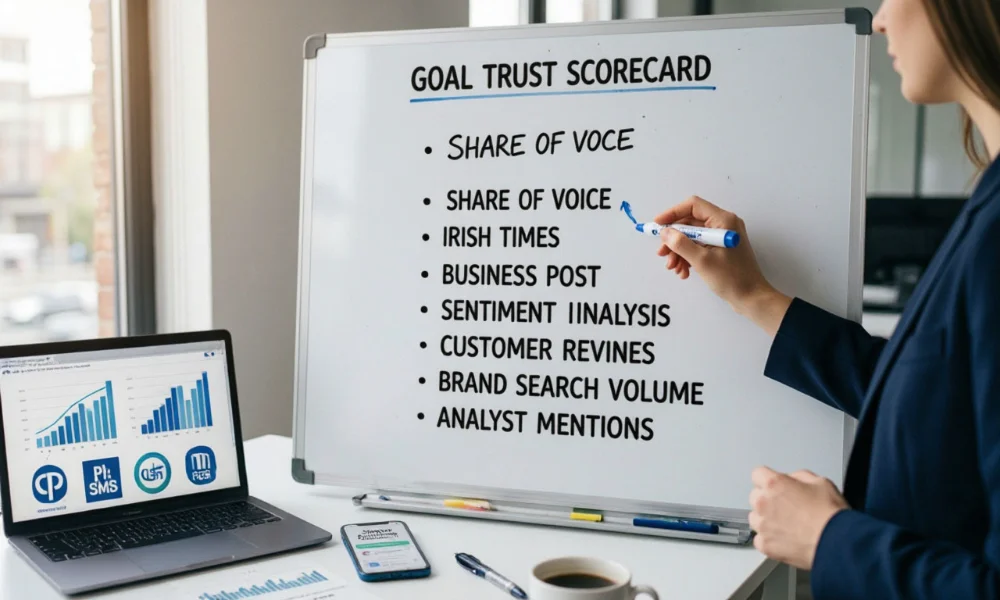
Pick 5-7 metrics that matter to your business. For a financial services firm, these might include:
- Share of voice in top-tier Irish publications (Irish Times, Business Post, Irish Independent)
- Sentiment score across media coverage (positive, neutral, negative)
- Review rating on platforms like Trustpilot or Google Reviews
- Brand search volume in Ireland
- Citation frequency by industry analysts or regulators
- Social engagement on LinkedIn and X
- Website traffic from media referrals
Step 2: Choose Your Tools
Several platforms can help you track these metrics:
- Cognito Core offers real-time brand measurement for financial services firms. It tracks coverage volume, competitor share of voice, sentiment and spokesperson performance.
- Onclusive provides a quality measurement framework that focuses on content relevance and publication authority.
- Alpha Market Flow offers a PR Intelligence framework designed specifically for fintech and Web3 firms.
In Ireland, you can also work with local reputation agencies. The Reputations Agency (part of Wunderman Thompson) offers reputation audits and management services for Irish brands.
Step 3: Establish a Baseline
Before you start measuring, know where you stand. Run a full audit of your current coverage, reviews and search presence. This gives you a starting point.
Step 4: Track and Analyse
Collect data monthly or quarterly. Look for trends. If sentiment drops, find out why. If share of voice grows, learn what worked.
Step 5: Act on the Data
Use your trust scorecard to make decisions. If visibility is low, increase your press outreach. If sentiment is negative, prepare a crisis plan. If reviews are weak, improve customer service.
Example Trust Scorecard for an Irish FinTech Company
Imagine you are a FinTech startup in Dublin. Your trust scorecard might look like this:
| Metric | Current Value | Goal | Status |
|---|---|---|---|
| Share of voice in top media | 8% | 15% | Needs work |
| Sentiment (positive) | 65% | 80% | Improving |
| Trustpilot rating | 4.2 | 4.5 | Good |
| Brand searches (per month) | 120 | 300 | Needs work |
| Analyst citations | 2 | 5 | Needs work |
| LinkedIn engagement | 3% | 5% | Improving |
This scorecard shows the company needs to work on media visibility and analyst authority. The team can focus efforts on these areas.

How a Trust Scorecard Helps in a Crisis
A crisis can happen at any time. A data breach. A regulatory review. A negative article. In financial services, a crisis can destroy a reputation in days.
A trust scorecard helps you prepare. If you see sentiment dropping, you can act before the situation gets serious. If you notice negative reviews rising, you can improve service before it becomes news.
During a crisis, the scorecard gives you an objective picture. You know what is being said about you in real time. You can measure the effect of your crisis actions. And you can see when your reputation starts to recover.
The Role of Human Judgment
A trust scorecard gives you data. But data does not tell the whole story. You still need human judgment.
A journalist might have written a negative article because of a personal dislike. A review might have been left by a competitor. A trend might be caused by an external event unrelated to you.
Use the trust scorecard as a foundation. Then add context. Talk to journalists. Ask customers. Read between the lines.
Steps to Implement in Your Company
If you are ready to start, here is an action plan:
- Gather a team. Assign one person to be responsible for the trust scorecard.
- Choose metrics. Start with 5-7 key indicators.
- Set up tools. Use free versions if your budget is limited.
- Run an audit. Document your current state.
- Set goals. Define where you want to be in 6 months.
- Track monthly. Collect data and analyse trends.
- Report. Share results with your team and leadership.
- Adjust strategy. Change your approach based on the data.
Conclusion: Trust Is Measurable
Trust does not have to be an abstract idea. You can measure it just like you measure revenue or traffic. A trust scorecard gives you objective data about your reputation.
In the Irish financial sector, trust is currency. Companies that know how to build and measure it gain an advantage. They attract more clients, get better media coverage, and handle crises more easily.
Start building your trust scorecard today. It will take time and effort. But the result is worth it – a stronger reputation that works for you every day.
Need help building a trust scorecard for your financial company? Contact Simpson Financial & Technology PR for expert guidance tailored to the Irish market.